


Covid-19 has increased the risk of churn. But is customer success ready for covid-19? What can customer success do to prevent churn?


 Your new post is loading...
 Your new post is loading...
Your new post is loading...
 Scoop.it!
Covid-19 has increased the risk of churn. But is customer success ready for covid-19? What can customer success do to prevent churn? 
No comment yet.
Sign up to comment
Scoop.it!

Why is employee engagement important? Here are 11 statistics that show why increased employee engagement has significant business impact.
Barry Deutsch's insight:
Positively scary statistics about employee engagement. I've been preaching these issues for about a decade.
Unfortunately, most companies have ignored me. Everyone has been too busy being reactive during the last decade of economic expansion. We're too busy to work on things that are important, but are not urgent.
Now we're reached a point where it is urgent also. As we emerge in 6-12 months from the current recession, will you emerge stronger and retain your best people - or will you try to pick up where you left off and potentially lose some of your best talent. Fixing these organizational/cultural issues are critical if you want to build a stronger organization.
Scoop.it!

Self-evaluations give employees a voice in their performance review. Learn the advantages they bring to your appraisals and how you can make employee self-reviews part of your organization's performance management process.
Barry Deutsch's insight:
Self-Evaluations by employees of their performance should be one of the pillars of your performance management process. Here are some ideas from a recent article on how to build self-evaluations into the process. Even if this is already part of your process, it might serve as a great review/assessment.
Scoop.it!

As the world is getting more accustomed to working from home, most of the work has shifted online. From in-house meetings to client meetings as well as staff/employee management performance. But what exactly goes on in the conference calls? Whether video or audio. When work conference calls are being made,
Barry Deutsch's insight:
As simplistic as it might seem on the surface, helping your team members to understand the differences between running online virtual meetings is radically from physically being around the table.
Are you coaching and preparing your team members to be very successful in organizing and running online virtual meetings for their team, interdisciplinary teams, and customer teams?
This is one of the areas we explore in the workshop/webinar I am doing for Vistage Groups and Members on "Managing Remotely in a Crisis."
Scoop.it!

Tips on how to make virtual employees feel involved by making the most use out of technology, office visits, and engaging them in company culture.
Barry Deutsch's insight:
Some good ideas about working remotely and understanding the different personality type styles so that managers can be more effective in managing vs. applying a "one approach" fits everyone mentality.
Is now the time to improve the sensitivity and awareness of your management team to how people want to manage and what they need in terms of feedback and communication?
Scoop.it!
Barry Deutsch's insight:
Good article in HBR. One of the key points I'm stressing in my workshop on Managing Remotely in a Crisis is that now is great time to be working on elements of your culture and aligning your purpose with who each employee matters.
Scoop.it!

Communication professionals need strategies and tools for building trust, creating structure and protecting brands, while keeping up with a very fluid situation.
Barry Deutsch's insight:
Sometimes we overlook simple things in managing people - especially remotely. This article references numerous studies that show employees want information from the CEO and direct manager. I'm finding in my workshops on managing remotely for Vistage groups and member companies that the number one element is weak communication.
I really liked the recommendation in this article about front line managers building other rituals and structures with their teams to improve the sharing of information, fun and team building, and overall interaction.
Most people feel alone, isolated, and separated at home - how can you help them feel like they are part of the organization and that they matter?
Scoop.it!

Truly having a feedback-rich culture can differentiate an organization when it comes to candidate attraction and employee retention.
Barry Deutsch's insight:
Would you rate your organization as being "feedback-rich?" If not, are you running the risk of losing good people, low engagement scores, a lack of productivity, and difficulty in attracting rockstars?
Scoop.it!

Did you know that the number of remote workers has grown by 140% since 2005? That’s what data from Global Workplace Analytics indicate. Now consider this: 80% of employees reported they’d be more loyal if they had more flexible work options, such as working from home.
Barry Deutsch's insight:
One of the biggest issues surfacing in my webinars on how to manage employees remotely is communication = how much, when, what channels. Here are some ideas/thoughts around improving communication with your team working from home.
Scoop.it!

Acknowledging your employee’s hard work is crucial to a smooth-running workplace. However, if it isn’t implemented correctly, a company can quickly see its workforce losing productivity. Why recognition is important Employee recognition is the acknowledgment of an individual’s or team’s effort or...
Barry Deutsch's insight:
A few core thoughts on how to structure an effective employee recognition program and some of the pitfalls to avoid to prevent failure. It's particularly important in working with remote workers to have a good recognition/reward program.
Scoop.it!

From
hbr

“We have a great culture.” We have all heard it. We have all said it. But what does that mean? Ping-Pong tables, free meals, and beer on tap? No.
Barry Deutsch's insight:
Good summary on issues related to culture, including observation of executives and managers in the execution of values. Perhaps, most importantly was the comment about employees wanting to know what's expected of them - which is now amplified exponentially given that most of the work force is at home "out of sight/out of mind".
Fear and uncertainty will cause your best performers to leave your organization - they'll find jobs instantly no matter what is happening in the economy. You'll be left with average and mediocre employees unless you being to start taking action now on your culture.
Scoop.it!

Recognizing employees and making them feel valued at work are the keys to creating an engaging work environment. We listed out 20 ideas for your next employee recognition award....
Barry Deutsch's insight:
Struggling to think of ways to recognize your employees? Here are 20 great ideas. Pick one to start changing your culture and showing your employees how much you appreciate them.
Scoop.it!

I'm giving you a lot to think about here because these statistics on employees faking happiness at work are pretty compelling....
Barry Deutsch's insight:
If 81% of unhappy employees fake happiness and 50-70% are not engaged/unhappy at work - that's a big problem. When mainstream publications like Forbes start to highlight this as an issue - executives should sit up and take notice before it's too late.
In my retention workshop, one of the biggest frustrations executives mention is a concern of a lack of working hard, productivity, and effort. Duh - you're not seeing it because so many of your employees are not engaged and are unhappy.
The big question is: what's your action plan to fix it?
|
Scoop.it!

As the Coronavirus/COVID-19 pandemic has escalated, businesses are trying to be proactive with their employee and customers’ hea...
Barry Deutsch's insight:
Here are some good tips for employees about how to work at home - especially for those for which this is a new experience. I'm finding most of my clients are NOT providing coaching and resources to help their employees be more effective as a remote worker. The assumption is just work the same as you did in the office - nothing could be further from the truth. Your employees desperately crave your guidance, coaching , and support in how to be productive and successful while working from home.
Scoop.it!

Across the world, employee engagement has flatlined. In many developed countries, productivity is stagnating
Barry Deutsch's insight:
A couple of key points came to me in reading this article. First, are you linking metrics of employee engagement to work results/outputs?
Secondly, are you trashing your annual performance appraisal process to make performance management more relevant by doing it on a structured monthly basis?
Two key points about improving performance management. Most companies are still stuck in a 1970ish model of sadistic annual performance evaluations and no relevance to employee engagement.
Scoop.it!

A look at why in-house employee recognition programs fail, and the potential solutions...
Barry Deutsch's insight:
Here's a contrarian view of why self-run internal employee recognition programs fail. Granted, the authors are biased since they are recommending their software SaaS model. However, I've see an extraordinary explosion in some very good SaaS apps for companies to more effectively manage employee engagement - apps for tracking success factors, projects, recognition programs, employee satisfaction, and many others.
Is now a good time to look at some of these app-based tools as many of your team members are remote?
Scoop.it!

Working remote for the first time? Here are some tips from a veteran.
Barry Deutsch's insight:
Are you helping and coaching your employees how to work more effectively from home? For many of your employees who have not worked at home - suddenly forced into working from a home office can be a rude shock.
In my workshop on Managing Remotely in a Crisis, I recommend coaching, providing resources, and helping your team get comfortable working from home.
Scoop.it!

From
tcbmag
Work culture expert and author Jody Thompson offers advice on managing a remote workforce....
Barry Deutsch's insight:
In this interesting article on the new normal of working from home, the author talks about a few elements of improving that process.
I particularly liked "if individuals and teams are clear on the results, then they can choose the most effective and efficient means to achieve measurable outcomes. Let your employees know what is needed and when so they can work efficiently and effectively."
As you know, this idea of defining success through the organization - whether it's the business objectives for key executives of a key executive or the KPIs for a field tech - this is something that gets amplified in a work at home environment.
I'm recommending as the NUMBER ONE best practice in having people work from home in my Managing Remotely in a Crisis Webinar that companies focus on defining and communicating expectations clearly and precisely (in written form), and then structure their entire management process around it for feedback, recognition, learning, and coaching.
If you can move the needle on defining success in the next 3 months, you'll go a long way toward improving productivity, efficiency, effectiveness, and flawless execution.
Scoop.it!
Working remote for the first time? Here are some tips from a veteran.
Barry Deutsch's insight:
I'm starting to conduct deep research on the process of managing a remote remotely. This article addresses a couple of issues many companies and remote workers are facing - the security issues around connecting to corporate networks through consumer home wifi routers, and how to carve out an effective home work space.
Now that I've done about 25 webinars for Vistage groups and members on How to Manage Remotely in a Crisis - a pattern of the most common issues facing companies are beginning to emerge. I'll share some of the best practices I've discovered from my clients in this space to overcome these issues.
Scoop.it!
Barry Deutsch's insight:
Interesting recent survey research on employee engagement. Take note of the very low percentage of employees who believe their CEO has a vision for the organization.
Scoop.it!

Job crafting—the process by which employees take on tasks outside their defined role—helps your company innovate and boost employee engagement.
Barry Deutsch's insight:
This is a great time to engage your employees in a discussion of crafting their job with goals, outcomes, deliverables, expectations, and KPIs that take advantage of their strengths. Have you started to have these conversations with your subordinates?
Scoop.it!
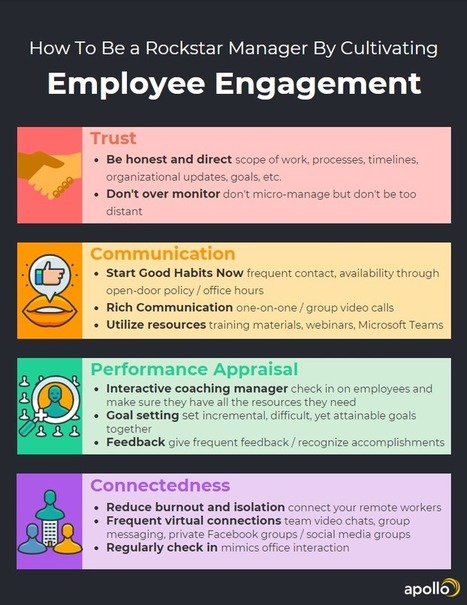
by: Brandon Currie, Training Specialist What does an engaged employee look like? Involved, committed, passionate, and empowered, demonstrating those feelings in their work behavior. Employee engagement is a predictor of positive business outcomes, such as profitability, increased job performance,...
Barry Deutsch's insight:
Some good ideas to think about when managing your remote team. I especially like the water cooler time/chat and coffee break ideas that many of my clients are implementing to replace the casual conversation that naturally takes place in the office.
Scoop.it!
In 1979, IBM was making headlines by becoming one of the first large companies to allow employees to work remotely.
Barry Deutsch's insight:
I really liked this Hubspot YouTube video titled about the caution of managing your remote workers like they are still on site. Written back in 2018, the message rings loud and clear for today's work environment. Some good takeaways here as more of your workforce transitions to remote work.
Scoop.it!

Here are some examples of Zoom virtual events/ideas centered around culture & community that you can bring to your organization while you work from home.
Barry Deutsch's insight:
Some good ideas from the Zoom blog about the problems and issues around culture when everyone is working from home. Have you tried some of these ideas yet?
Scoop.it!

When we measure happiness, we're measuring 8 different components in the employee’s experience to determine how they might impact your customer experience.
Barry Deutsch's insight:
There are 3 main areas that authors focus on in terms of an employee's experience: employee engagement, employee happiness, and employee satisfaction. All of these can impact customer satisfaction.
Many authors use these terms with overlapping definitions.
As a summary statement, there is a lot of overlap between the ideas. For example, this author talks about creating a positive work environment - this can affect engagement, happiness, and satisfaction.
For me, the bigger question is how do we measure the investment in retention or engagement tactics - is it through productivity KPIs, attendence, turnover, structured feedback from employee or customer surveys?
We know we should have a non-monetary reward/recognition system - but how do we determine if it is meeting our needs? What's the metric, measurement process, reporting, and action steps/milestones along the path of making improvements?
|







Although this article is written from the perspective of a Software/app company and how to limit churn - customers quitting, not paying, going to competitors.
Let's move the discussion away from just software companies to all companies - product and service (especially is you have a recurring revenue model).
What are some creative approaches you could take over the next 3-6 months to ensure you retain a significant number of your clients as the economy restarts and everyone scrambles after those same clients/customers?
This is the forward planning part of my workshop/webinar on Managing Remotely in a Crisis - how do we emerge stronger and more capable rather than simply picking up where we left off? How do we take the next 3-6 months to work on those back-burner projects that might allow us to gain a competitive advantage?